Harold Remembers the Way Home
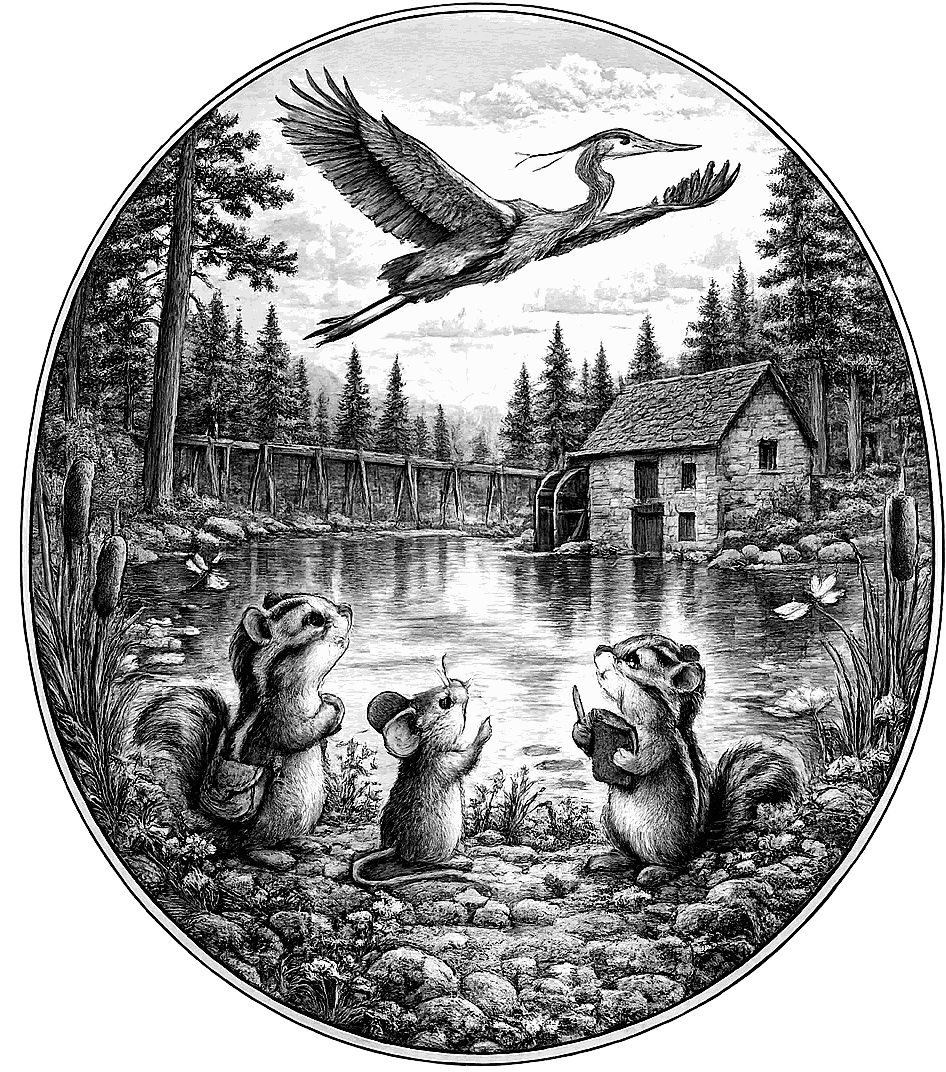
Early mornings at Young's Mill Pond were magical.
The people of Train Mountain were still tucked warmly into their beds, but the animals had already begun their busy day.
Birds greeted the sunrise. Dragonflies skimmed across the water. Frogs whispered from the reeds.
The pond seemed happiest before the rest of the world woke up.
The water was as smooth as polished glass, reflecting the tall ponderosa pines that stood watch around its edge. Dragonflies darted and hovered above the lily pads, their delicate wings catching the first rays of sunlight. Somewhere among the cattails, a red-winged blackbird called its familiar song.
Goldie skipped along the narrow path beside the pond.
"I wonder if Skipper is awake yet."
Pip peered across the water.
"Maybe he's still eating breakfast."
Mitch smiled.
"Dragonflies usually eat breakfast while flying."
Pip's eyes grew wide.
"That sounds difficult."
"It probably takes practice," Mitch replied.
The three friends wandered quietly along the shoreline, stopping every now and then to admire a blooming water lily or watch tiny ripples spread across the pond.
Goldie shaded her eyes.
"I don't see Skipper anywhere."
"Maybe he's visiting another pond," Pip suggested.
Just then...
A great shadow slipped silently across the water.
The children looked up together.
High above the pond, an enormous blue-gray bird glided through the morning sky.
His wings stretched so wide they seemed almost too large for the air to carry.
He circled the pond once.
Then again.
Goldie smiled.
"A Great Blue Heron!"
The graceful bird lowered his long legs as though preparing to land beside the water.
But just before his feet touched the reeds, he suddenly beat his wings, climbed back into the sky, and circled once more.
The children watched quietly.
"That's strange," Goldie whispered.
"What is?" asked Pip.
"If I were a Great Blue Heron, I'd land right here."
She pointd toward Young's Mill Pond.
"There's breakfast...there's water...and there's hardly anyone around."
The bird circled a third time.
Instead of settling near the water, he turned away.
He glided silently over the tops of the pine trees and Central Station.
At last, he stretched out his long legs and settled carefully on top of the highest pole he could find.
For a moment, no one spoke.
The bird was magnificent.
His feathers were soft blue-gray, with darker plumes along his back. His neck curved like a question mark, and his long beak pointed toward the distant mountains.
But instead of looking proud or peaceful, he looked worried.
He turned his head to the east.
Then to the west.
Then back toward the south.
His feathers lifted and settled.
Lifted and settled.
Goldie stepped closer.
“Hello up there.”
The bird startled so badly that one long foot slipped from the pole.
He flapped once, caught his balance, and peered down at them.
“Oh dear,” he said. “You found me.”
Pip tilted his head.
“Were you hiding?”
“Not exactly.”
The bird looked across Central Station and the entrance to Train Mountain again.
“I was hoping to appear as though I knew what I was doing.”
Mitch picked up his notebook.
“Were you successful?”
The bird considered this.
“Not especially.”
Goldie smiled.
“I’m Goldie. This is my brother, Mitch, and our friend Pip.”
The great bird dipped his head.
“My name is Harold.”
He looked toward the mountains once more.
Then toward the trees.
Then down at the three small faces watching him.
“This is rather embarrassing.”
“Getting lost?” Pip asked.
Harold gave a long sigh.
“No. Being found.”
Pip giggled, but Goldie noticed that Harold did not.
She moved a little closer to the pole.
“Are you lost?”
Harold straightened.
“I shouldn’t be.”
His voice sounded firm, but his feathers ruffled again.
“I have flown this way before.”
He turned east.
“At least, I believe I have.”
He turned west.
“Although perhaps not from this direction.”
Then he looked south again.
“I was following the lakes this morning. Everything looked familiar until suddenly none of it did.”
His words began coming faster.
“I caught a strong breeze. I may have drifted farther than I intended. Then the mountains looked different, and the trees looked different, and I could no longer see the water.”
He shifted from one foot to the other.
“I should know where I am.”
Goldie looked at Mitch.
Mitch looked at Pip.
Harold continued.
“I have flown this route for years.”
His voice tightened.
“I should not be sitting on a telephone pole in a place I do not recognize.”
He glanced at the brightening sky.
“I’ve already wasted too much time.”
“Maybe you could fly higher,” Pip suggested.
“I tried that.”
“Maybe you could follow the big train tracks,” said Goldie.
“I considered it.”
Mitch opened his notebook.
“Do you remember which direction you came from?”
Harold turned one way.
Then another.
“I did a moment ago.”
He swallowed.
“What if I cannot find my lake?”
No one answered.
The three friends had never met Harold before. They did not know where he lived, which lakes he followed, or how far he had traveled.
But they could see that he was frightened.
Goldie lowered her voice.
“We know some friends who might be able to help.”
Harold looked down at her.
“Do they know the way to Upper Klamath Lake?”
“I don’t know,” Goldie admitted.
Harold’s feathers lifted again.
“Oh.”
“But they are very good at helping when things feel confusing.”
Pip nodded eagerly.
“They helped us with the Great Pinecone Adventure.”
Harold blinked.
“The what?”
“It’s a long story,” Mitch said.
Pip grinned.
“It was a very important pinecone.”
Goldie looked up at Harold.
“Will you come with us?”
Harold hesitated.
Then he carefully opened his great wings.
“I suppose sitting here looking worried has not been especially useful.”
With one strong beat, he lifted from the pole and glided down to Young’s Mill Pond.
He stood beside them, taller than all three friends together.
Pip stared up at him.
“You looked smaller from the pole.”
Harold glanced down.
“So did you.”
Together, the unlikely little group set off toward Stockbridge.
Harold walked carefully, placing each long foot between the grasses and wildflowers.
Goldie and Pip hurried beside him while Mitch followed a few steps behind, writing as he walked.
Harold glanced back.
“What are you writing?”
“Observations.”
“About me?”
“A few.”
Harold’s feathers rustled.
“Should I be concerned?”
Mitch looked at his page.
“Probably not.”
They followed the shaded trail that wound away from Central Station toward Stockbridge.
Harold tried to walk calmly, but every few moments he would stop and look through the trees.
“Perhaps I should turn back.”
“Back where?” Pip asked.
Harold opened his beak.
Then closed it.
“That is an excellent question.”
Goldie stayed close to him.
“You don’t have to figure it out yet.”
Harold looked down at her.
“I should have figured it out already.”
Goldie did not know what to say to that.
Neither did Pip.
Mitch quietly closed his notebook.
They kept walking.
When they reached Stockbridge, the elders were gathered just as they had been before.
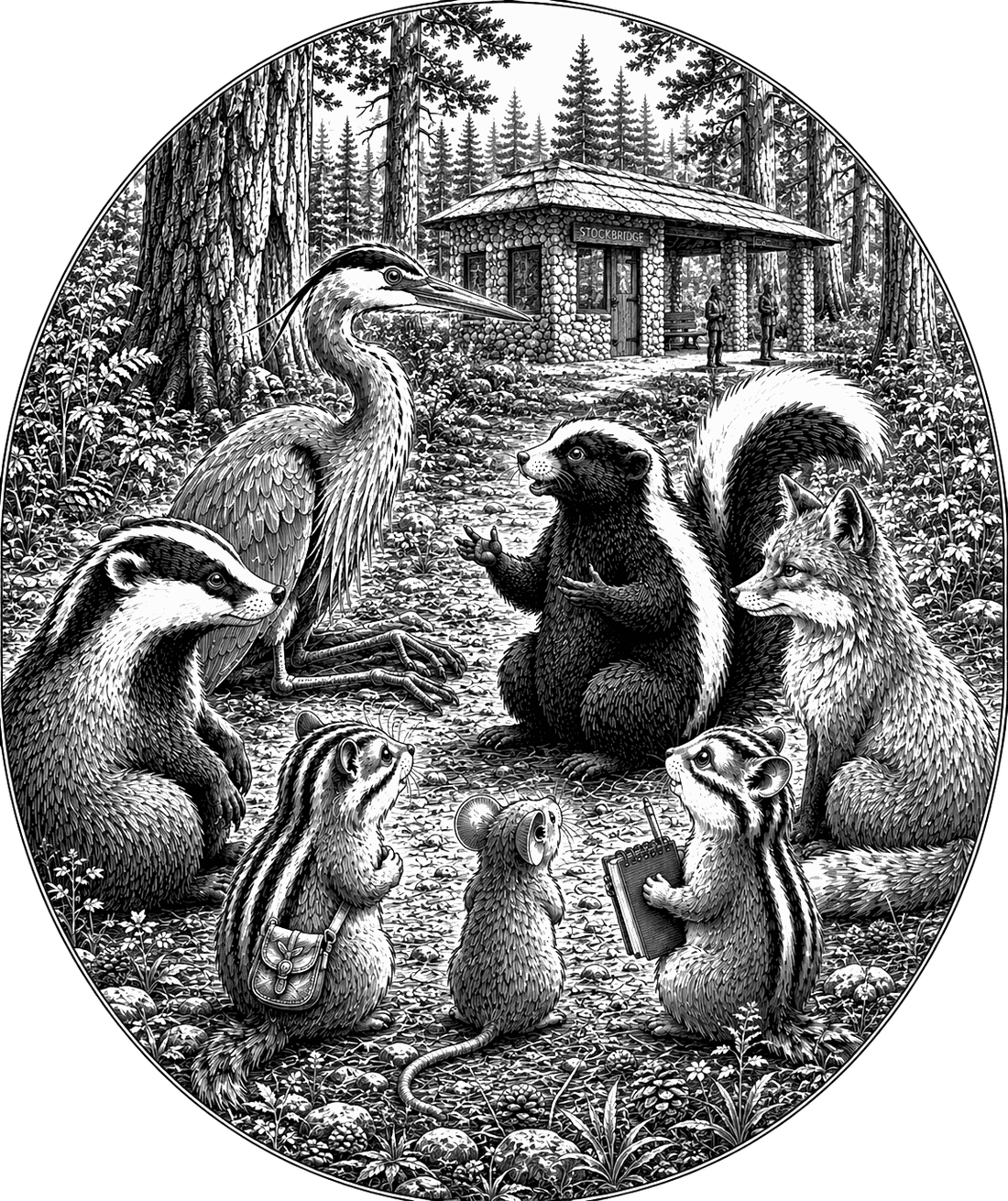
A broad-shouldered badger, quiet and watchful.
A neatly groomed skunk, her tail curled close.
A long-tailed weasel, alert, his bright eyes filled with curiosity.
And just beyond them, resting comfortably in the shade, a red fox—her coat deep and rich, touched with the colors of distant places.
Only one familiar face was missing.
Grandma Larkspur had already returned to Larkspur Hollow.
Goldie stopped.
“Oh.”
Mitch’s ears lowered slightly.
Pip looked around the clearing.
“She really did leave.”
They had hoped Grandma Larkspur would know exactly what to do.
She always seemed to know which questions to ask and when to wait for an answer.
For a moment, the children hesitated at the edge of the clearing.
The badger noticed them first.
His eyes moved from Goldie to Mitch, from Mitch to Pip, and finally all the way up to Harold.
The fox lifted her head.
The skunk smiled.
The weasel’s bright eyes grew even brighter.
The badger gave a gentle nod toward the open spaces beside them.
“Come,” he said. “There is always room for a few more in our circle.”
The children relaxed at once.
It was the very same circle of wise friends who had welcomed them not so long ago and patiently helped them unravel the mystery of the Great Pinecone Adventure.
Harold remained just outside it.
The skunk noticed.
“There is room for you too.”
Harold glanced behind him, as though there might be another great blue heron standing there.
“For me?”
“For anyone who needs a place to rest,” she said.
Harold carefully folded his long legs beneath him and settled beside the children.
Even sitting down, he was enormous.
The badger waited.
No one rushed to explain.
At last, Harold cleared his throat.
“My name is Harold.”
The elders greeted him warmly.
“I am afraid I have become lost.”
The badger nodded.
“Perhaps.”
Harold blinked.
“Perhaps?”
“You certainly do not know which direction to go,” said the badger. “But we have not yet discovered how much you do know.”
Harold’s neck straightened.
“I know that I should not be here.”
The fox’s eyes softened.
“Why not?”
“Because I know my way home.”
“Usually?” she asked.
“Yes.”
“Then today is unusual.”
Harold stared at her.
The fox rested her chin on her paws.
“Unusual things happen.”
Harold’s shoulders lowered the smallest bit.
“I suppose they do.”
The skunk studied him quietly.
“You are frightened.”
Harold looked embarrassed.
“I’m sorry.”
Her tail curled a little closer.
“There is nothing to apologize for.”
“I must look foolish.”
“You look frightened,” she said. “Those are not the same thing.”
Harold looked down.
The children were very still.
The skunk continued gently.
“Sometimes our hearts begin running before our thoughts have tied their shoes.”
Pip glanced at his own feet.
Harold let out a small sound that was almost a laugh.
The badger nodded.
“No one thinks clearly while running in circles.”
“I have not been running in circles,” Harold said.
The badger looked at him.
Harold considered the many directions he had stared from the telephone pole.
“Not with my feet, perhaps.”
The weasel leaned forward.
“Then before we decide which way you should fly, perhaps we should help your thoughts catch up.”
Harold looked from one elder to another.
“Aren’t you going to ask me where I came from?”
“Eventually,” said the weasel.
“Aren’t you going to point me toward the lake?”
“Perhaps,” said the fox.
“Do you know where Upper Klamath Lake is?”
The elders exchanged glances.
The fox smiled.
“That is not the first question.”
Harold’s feathers began to rise.
Goldie noticed.
So did the skunk.
She spoke quietly.
“You are safe here.”
Harold turned toward her.
“No one is waiting for you to know the answer,” she said.
The clearing grew still.
A soft breeze moved through the pine branches.
Somewhere beyond Stockbridge, a little locomotive gave a distant whistle.
Harold closed his eyes for one moment.
When he opened them, his feathers had begun to settle.
The badger lowered his voice.
“Now we can begin.”
The long-tailed weasel moved a little closer.
“Tell us about home.”
Harold looked puzzled.
“What would you like to know?”
“What is the first thing you notice when you return?”
Harold thought.
“The water.”
“What about it?”
“It stretches for miles.”
“What color is it?”
“That depends.”
The weasel smiled.
“On what?”
“The hour. The weather. The wind.”
Harold looked beyond the circle, but this time he did not seem to be searching the trees. He seemed to be seeing something much farther away.
“In the early morning, the water can be silver. At midday, it turns blue. When the clouds gather, it becomes dark and deep.”
“And at sunset?” asked Goldie.
Harold’s eyes softened.
“Gold.”
Pip smiled.
“Like Goldie.”
“Not quite as bright,” Harold said.
Goldie beamed.
The weasel continued.
“What does morning smell like?”
“Cool water,” Harold answered.
He paused.
“Fresh reeds.”
Another pause.
“Wet earth. Mud warmed by the first sunlight.”
The skunk nodded.
“What do you hear?”
“Red-winged blackbirds.”
“Anything else?”
“Frogs.”
Harold’s voice grew quieter.
“Geese calling in the distance.”
He tilted his head.
“And the wind moving through the cattails.”
“What sound tells you that you are nearly home?” asked the fox.
Harold thought longer this time.
“The blackbirds,” he said at last.
“Why them?”
“They gather thickly near the marshes. When I hear them calling from both sides, I know the open water is close.”
Mitch ever so slowly and ever so quietly opened his notebook.
The elders had not asked Harold for a single direction.
They had not mentioned north or south.
They had not drawn a map.
They simply kept asking about home.
The weasel spoke again.
“What does the breeze feel like there?”
Harold lifted his head slightly.
“Cooler over the water.”
“Which side of your feathers does the morning sun warm when you are flying home?”
Harold closed his eyes.
“The left.”
His eyes opened again.
“At least, it does when I return in the morning.”
The badger nodded.
“And what do you see from above?”
“Marshes.”
Harold’s breathing slowed.
“Long green stretches broken by shining water.”
“What else?” Pip asked.
“White pelicans sometimes drift near the open lake.”
Harold smiled.
“They look very grand from a distance.”
“Are they grand up close?” Goldie asked.
Harold considered.
“They are pelicans.”
The fox chuckled.
Pip tried not to.
Harold’s smile widened.
For the first time since Young’s Mill Pond, he looked less like a worried stranger and more like someone they might know.
The weasel rested his paws in front of him.
“What do you pass before you reach the lake?”
“A line of low hills.”
“And before that?”
“Pine forest.”
“And before that?”
Harold’s eyes opened wider.
He looked toward the trees surrounding Stockbridge.
"A meadow..."
He closes his eyes.
"...with tall ponderosa pines."
Another breath.
"...and little train tracks circling around it."
Goldie looked at Mitch.
Mitch looked at Pip.
Pip’s mouth formed a small, round O.
Harold slowly stood.
His feathers lay smooth against his back now.
The fox watched him carefully.
“There he is,” she said.
Goldie looked around.
“Who?”
The fox smiled.
“Harold.”
The children looked up at the great bird.
The fox continued.
“Until now, fear had been doing most of the talking.”
Harold lowered his head.
“I did talk rather a lot.”
“You had a great many worries to carry,” said the skunk.
“And now?” asked the badger.
Harold stood very still.
“I am listening.”
A breeze slipped through the trees.
It moved across the clearing, stirring the fox’s rich coat, the skunk’s curled tail, and the small leaves beside Mitch’s notebook.
Harold raised his head.
The breeze brushed over his feathers.
He turned slightly.
Then turned again.
Everyone waited.
No one pointed.
No one whispered.
Harold closed his eyes.
He took a long breath.
The wind moved over him once more.
His eyes opened.
“The marsh.”
His voice was barely more than a whisper.
Goldie leaned forward.
“What?”
“I can smell it.”
Harold stretched his neck toward the southwest.
“Water and reeds.”
He opened his wings halfway.
“The morning sun was on my left when I arrived.”
Mitch’s pencil began moving.
“If it warms your left side when you fly home,” he said, “then—”
Mitch stopped himself.
The badger glanced at him.
Mitch lowered his pencil.
Harold needed to finish.
The great heron turned until the sunlight touched his left wing.
His eyes shone.
“The low hills.”
He looked beyond the pines.
“They are there. I could not recognize them because I was looking from the wrong side.”
His wings opened fully.
“The meadow. The pines. The forest beyond.”
He drew in a deep breath.
“I know this way.”
Pip bounced to his feet.
“You found your lake!”
Harold looked toward the distant sky.
Then he smiled down at Pip.
“No.”
His voice was calm now.
“I remembered it.”
Goldie looked from Harold to the elders.
“But you never told him which way to go.”
The fox nodded.
“No.”
“You could have,” Pip said.
“Perhaps.”
“Then why didn’t you?”
The fox looked toward Harold.
“If we chose his path for him today, what would happen the next time the wind carried him farther than he intended?”
Pip thought.
“He might need someone to choose it again.”
The weasel nodded.
“But now he knows what to notice.”
“The sun,” said Goldie.
“The wind,” said Pip.
“The sounds near the marsh,” said Mitch.
“And the memories he carries with him,” said the skunk.
Mitch watched Harold.
His breathing was calm.
His feathers were smooth.
His eyes were clear.
“Oh,” Mitch whispered.
Goldie turned.
“What?”
Mitch smiled.
“They weren’t helping him find the lake.”
Pip tilted his head.
“What were they doing?”
Mitch looked up at Harold.
“They were helping him find himself.”
The elders said nothing.
They did not need to.
Harold folded his wings and bowed his long neck to the circle.
“I do not know how to thank you.”
The badger gave a small nod.
“You already have.”
Harold looked confused.
“You stopped.”
The skunk smiled.
“You listened.”
The weasel’s bright eyes twinkled.
“You remembered.”
The fox rose from the shade.
“And now you will carry the answer with you.”
Harold looked at Goldie, Mitch, and Pip.
“You brought me here even though we had never met.”
Goldie shrugged.
“You looked like you needed help.”
“And you did not think I was foolish?”
Pip shook his head.
“You were scared.”
Mitch closed his notebook.
“Scared and foolish are not the same thing.”
Harold looked toward the skunk.
She smiled.
He looked back at the children.
“I hope, if I ever meet someone whose heart is running faster than their thoughts, I will remember how you treated me.”
Goldie smiled.
“You can lend them some of your calm.”
Harold’s golden eyes softened.
“I would like that.”
He stepped into the open clearing.
With three powerful beats of his wings, he rose above Stockbridge.
The children hurried out from beneath the trees to watch.
Harold circled once.
Then twice.
This time, he was not searching.
He looks down.
Looks at the children.
Looks at the elders.
He turned toward the southwest and called down to them.
He circles once.
Looks down.
Smiles.
"You didn't help me find my way home."
Everyone looks puzzled.
"You reminded me that I already knew the way."
Pip waved both paws.
“Come back sometime!”
Harold’s answer drifted down on the wind.
“I believe I shall!”
He climbed higher over the pines, his long wings carrying him toward the low hills, the marshes, and the shining waters of Upper Klamath Lake.
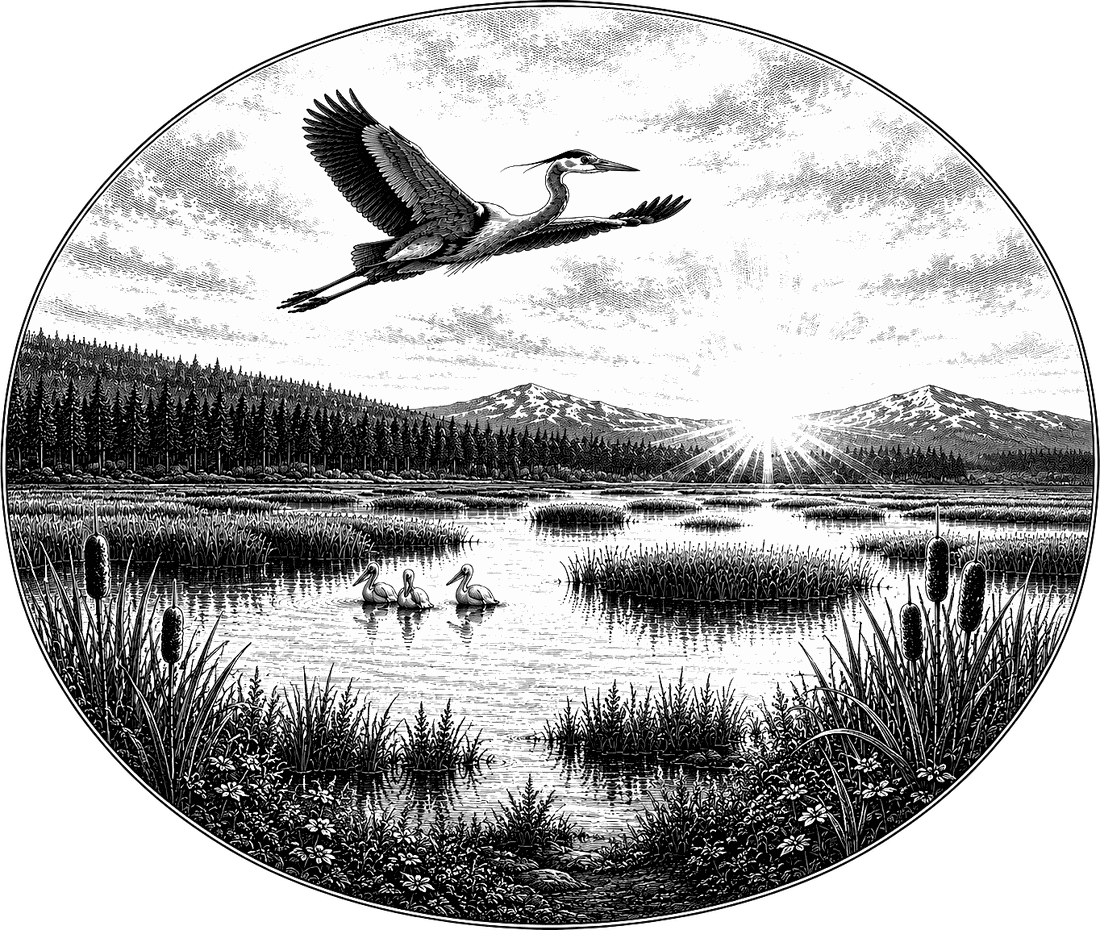
They watched until he became a small blue-gray shape against the sky.
Then a speck.
Then nothing at all.
The three friends followed the trail back toward Central Station.
For a while, they walked quietly.
Pip was the first to speak.
“The elders never solved Harold’s problem.”
Goldie nodded.
“They helped him solve it.”
Mitch opened his notebook as he walked.
Goldie glanced over.
“What are you writing?”
Mitch thought for a moment.
Then he wrote:
Sometimes the kindest thing we can give someone is enough calm to help them find their own answer.
Goldie smiled.
“I should probably write that down.”
Mitch grinned.
“I already did.”
When they reached Young’s Mill Pond, the old telephone pole stood empty against the afternoon sky.
Pip looked up at it.
“It seems smaller now.”
Goldie nodded.
“Maybe it is.”
Mitch tucked his notebook safely under his arm.
“Or maybe Harold made all of Central Station feel bigger.”
The three friends crossed the grass together, carrying home something they had not brought with them that morning.
Not a feather.
Not a map.
Not even a pinecone.
Something quieter.
The understanding that when someone is frightened, kindness does not always mean giving them the answer.
Sometimes it means staying beside them long enough for the answer to return.